It's all about
the metal.
RIDR wasn't built in a boardroom. It was built in a garage by someone with too many bikes and a notebook he kept losing.
Seven bikes and a memory problem
I have seven motorcycles. That's the short version. The longer version is that they came to me one at a time over a lot of years, and some of them came home twice.
The first Harley I ever bought was a 2012 Fat Boy Lo. I owned it, then traded it, and a year later I ran into the guy who'd bought it from the dealer. He was ready to move on. So I bought it back. The bike that taught me what I was doing has been in my garage twice now, and it's staying this time.
The newest one is a 2025 Grey Ghost — #1048 of the 35th Anniversary build. I've been logging hours on it customizing every bracket and chrome surface I can get my hands on. Then there's the 2024 Road King, which is my wife's. The 2017 CVO Breakout my son rides — he hasn't quite finished paying me for it. A 1995 fully custom Softail. A 2002 Road King. And a 1976 Triumph Bonneville T140 that's older than I am.
Three of those bikes belonged to my friend Jon.
Jon Story
Jon taught me how to ride. He'd open up his 2002 Road King through the North Georgia mountains and I'd chase him on the Fat Boy Lo. For a long time I couldn't keep up. He had a way of moving through curves that made the rest of us look like we were thinking too hard.
He wasn't a crowd guy. In his younger days he was the life of the party — that's how everyone met him. But by the time I knew him well, he had two friends. I was one of them. He kept the world small on purpose. The rest of his energy went into work and the metal.
He sold pools up and down the East Coast for years. Then he moved into commercial real estate. He did well at both. But what he actually cared about was the garage. He had a 1967 Chevelle. A 1969 Camaro. A 2010 Camaro. A 1951 Mercury. And more besides — he was always rebuilding something. I helped him on most of them. He helped me on all of mine.
He'd say it about everything: "It's all about the metal." He meant the steel, the chrome, the V-twins, the small-blocks. He meant the work of keeping it all running. He said it so often that it stopped being a phrase and started being a way of seeing things.
Jon passed of old age. His mom, dad, and sister were already gone. He had one cousin I've never met. My family and I were what was left.
Before he passed, I bought his 2002 Road King from him. The 1995 Softail came over too — we'd customized that one together for years. The 1976 Bonneville was in his will. He wanted it to keep running.
Spot, and everything else
Jon was an artist. Pencil, paint, and metal. He could draw, he could weld, he could see a junk pile and know which pieces wanted to be something.
When I changed the suspension on one of my cars, I gave him the old coil springs. He took them, plus a pile of Harley parts — connecting rods, valve stems, a couple of sprockets, a length of chain — and welded me a dog. I named him Spot. He stays really well. Very house-trained.
But Spot wasn't a one-off. Jon built furniture, sculpture, anything you could put a torch to. Console tables. Benches. A riveted steel and leather couch that looks like it came out of an industrial workshop. Every piece he made carried his signature — a hand-cut "X" welded somewhere on it, his mark. He signed his work the way painters sign canvases.
The work he left behind
Three pieces from Jon's garage. The dog he welded me, a leather-topped bench, and a riveted couch with hand-cut perforated panels. Every piece has the "X" somewhere on it.
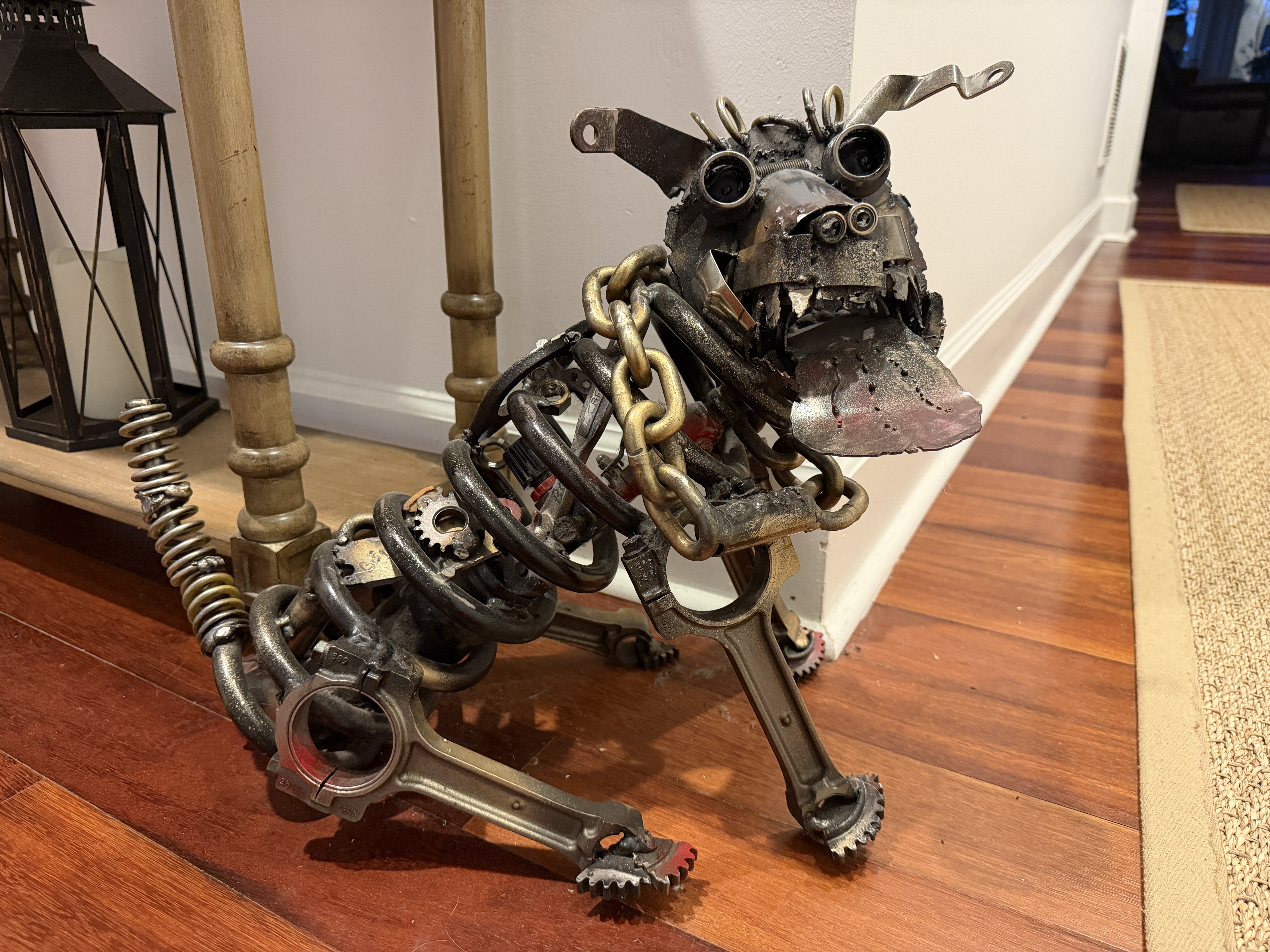
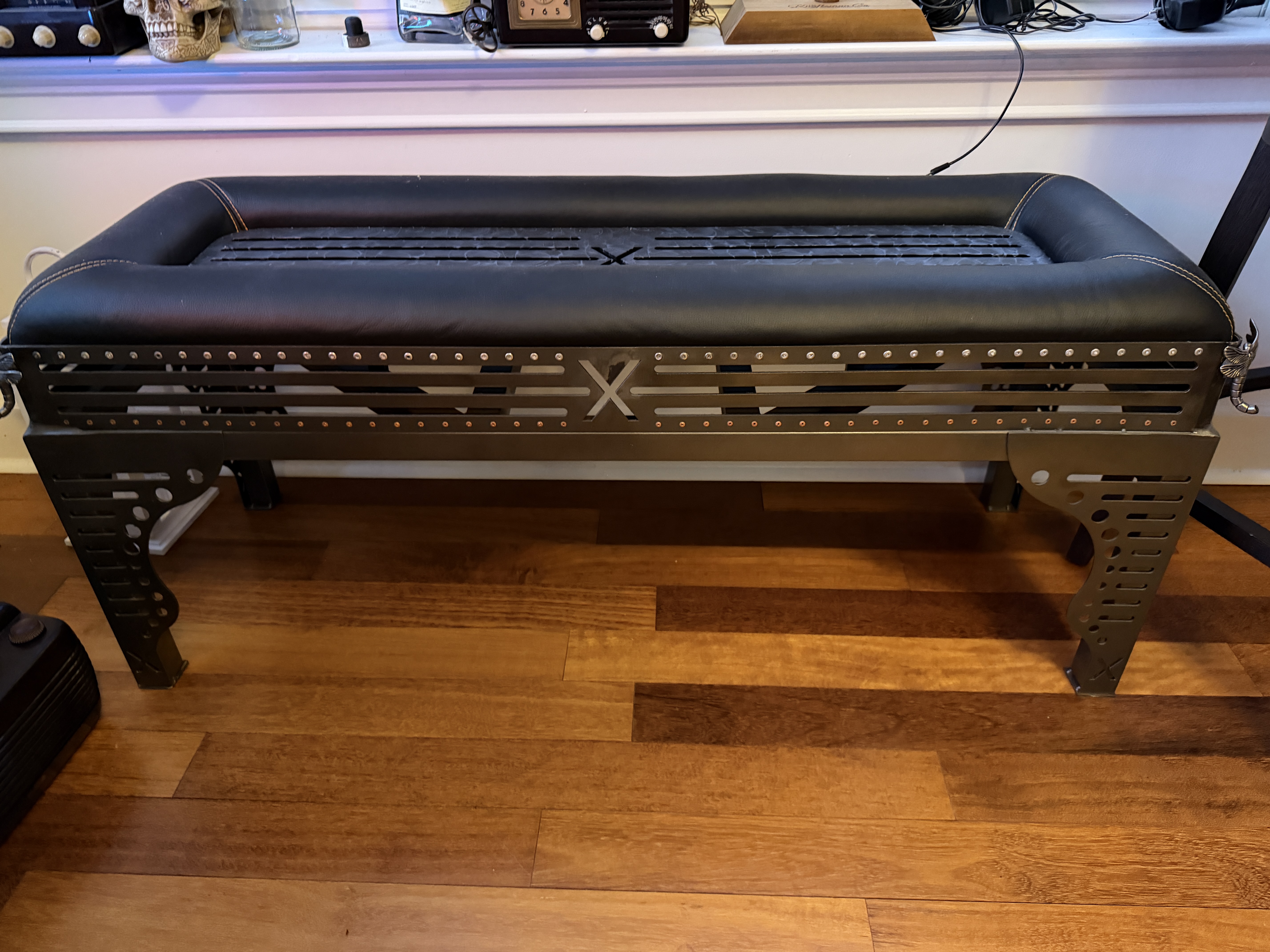
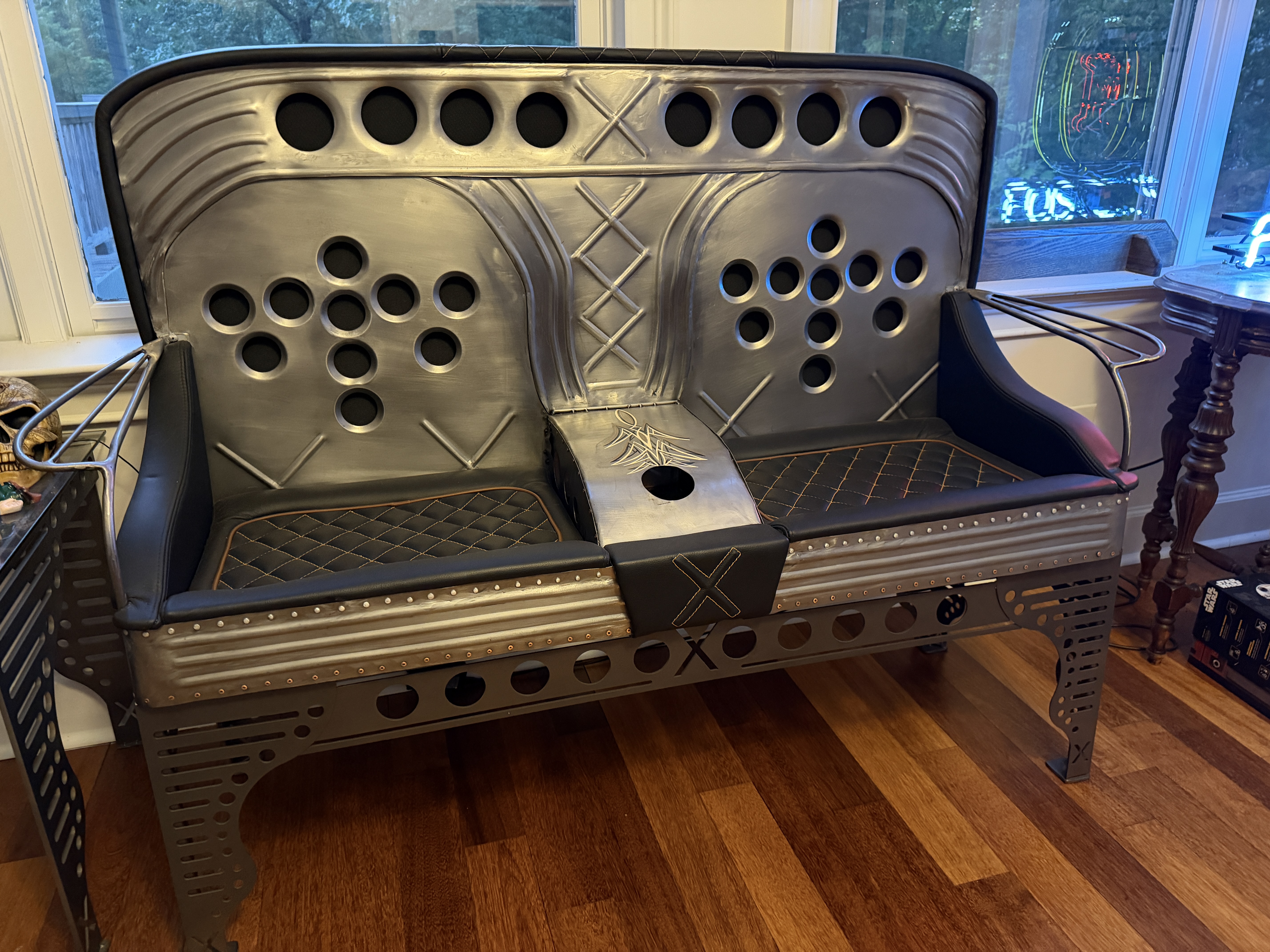
Spot lives in my house. Every time I walk past him I think about what Jon could do with a torch and a pile of parts. The dog has a brake-rotor face and Harley-piston legs and the patience of a sculpture that knows it's going to outlast all of us.
Why RIDR exists
Between the seven bikes and the cars we worked on together, there was always something that needed service, parts, or attention. I couldn't keep it straight. Receipts in shoeboxes. Half-remembered oil change dates. "Wait, did I do this on the Road King or the Softail?"
Other apps existed. They were built for people who own one bike and don't actually turn wrenches on it. They didn't understand multi-bike garages. They didn't understand someone who'd spent a Saturday changing the primary fluid and wanted that recorded next to the part number and the receipt total. They didn't understand that the receipt itself is part of the record — that ten years from now the receipt is what tells you who installed what, where, and for how much.
So I built one.
RIDR is a maintenance log for people who actually wrench on their bikes. Multi-bike from day one. Receipt scanning that captures every line item, not just the total. Rides logged with GPS so you know what the bike's been doing between services. Service schedules per bike, per service type. Costs tracked over time so you can answer questions like "how much did keeping the Road King running really cost me last year?"
It's built by someone who uses it every day on seven real bikes. When something doesn't work right, I feel it before any user does. When a Harley dealer's receipt format breaks the scanner, I see it on a Tuesday at my kitchen table.
The garage
- 2025 Harley-Davidson Fat Boy "Grey Ghost" 35th Anniversary, #1048
- 2024 Harley-Davidson Road King My wife's
- 2017 Harley-Davidson CVO Breakout My son's
- 2012 Harley-Davidson Fat Boy Lo Bought it twice
- 2002 Harley-Davidson Road King Jon's
- 1995 Harley-Davidson Softail Jon's, fully custom
- 1976 Triumph Bonneville T140 Jon left it to me in his will
RIDR exists because Jon taught me that taking care of the metal isn't a chore. It's a relationship. The bikes outlast the people, and the records you keep are part of how you hand them off.
So this app is, in some way, a tribute to him. To the years of him saying it. To the cars we rebuilt together. To the dog made of springs and chain and connecting rods sitting in my house. To three of his bikes still running in my garage.
It's all about the metal.